Isabella
Schlichtekrull
The Burning of witches is a cruel chapter in history. An estimated 40.000 people, mostly women, fell victim to it. Only a few survived, and even fewer, 131 women (1), had the courage to file a complaint against it with the Imperial Chamber Court in Speyer. Between 1600 and 1610 there were 17 such cases. One of these 17 women was Isabella Schlichtekrull. Here is a unique case that would last 25 years, spanning the reigns of two German emperors and three Pomeranian dukes.
Pomerania
A week before Pentacost 1589, Isabella was arrested in her home, thrown into the tower and subjected to torture the following morning. The accusation was that she had practised witchcraft. Although the Pomeranian dukes had undertaken to apply Emperor Charles V’s „Peinliche Hals- und Gerichtsordnung“ (Carolina) of 1536 in their courts in Stettin and Wolgast, matters were different in the lower court of the Hanseatic city of Anklam in the Duchy of Pomerania-Wolgast. Apparently, there was no „good, reasonable judge“ to whom the „honest complaint“ should have been submitted in accordance with the court regulations. It was this judge who was to decide on the „painful interrogation“ of the accused. Nore was there a clerk to record the charges, interrogation and witness statements. The mayor and city council knew how to help themselves: they left the legal proceedings entirely to the executioner alone. He made short work of them and immediately resorted to torture in order to obtain a confession, the easiest way to send someone from life to death. Isabella later complained that she had been subjected to torture for three days and nights. During this time, „burning sulphur was thrown onto her naked skin“, which „tormented and frightened“ her and „did not leave a single part of her body intact“. (2) In addition, she carried her „dear unborn child“ close to her heart and had „not yet seen“ it. She lost her unborn child.
But Isabella survived the ordeal without confessing or accusing others of superstitious acts in an attempt to save her own life.
Isabella Schlichtekrull was a wealthy woman, born in 1555 into a prosperous family that belonged to the town’s upper class. Her father ran a brewery and an inn called Bohemien Forest (Böhmerwald) while his brother and nephew were lawyers in Greifswald. Her mother, the daughter of a mayor, inherited the brewery and a farm after her husband’s death. Unlike Lübeck law, which governed many Hanseatic cities, the laws of Anklam allowed widows to inherit property and retain custody of their children. In addition, she received an inheritance from her sister. Isabella had three siblings, two sisters and a brother. The sisters were well-off and married locally, while the brother, a true Hanseatic man, worked as a skipper and merchant at Stettin, conducting business as far a field as the Baltic States. However, he died young at sea. His share of their mother’s inheritance also passed to Isabella. After 1565, her parents probably fell victim to the plague.
But it was not only the plague that brought „great sorrow“ to the town and the surrounding country, claiming 2,000 lives, about one-third of the population. At the same time, devastating fires reduced entire streets to ashes, while crop failured, inflation and declining fish stocks added to the misery. The town coffers were empty as well, for the Hanseatic League demanded even greater contributions to its war chest, while the duke required funds for his court. Other changes also weighed heavily on the country. The Reformation was introduced by the dukes in 1535 following unrest among the guilds and towns people, but some refused to embrace the new faith. Among them was Isabella, who had been raised as a Catholic by her mother. It is even conceivable that she was named after Queen Isabella I. of Castile, known as the Catholic Queen. Isabella Schlichtekrull later stated in her inventory list: „Irem 16th part of Ships to Hispania“. (3) This indicates that she held shares in trade with Spain. The decline of the Hanseatic League posed yet another threat of prosperity. The small town on the Peene could no longer compete with the large ports of the North and Baltic Seas. The cargoes carried by its small trading cogs were simply too modest. In times marked by disease, loss, and fear for one´s life, many sought salvation in faith, superstition or greed. This was especially true during this period.
After the death of her parents, Isabella was taken in by her sister Anna. There she learned not only how to run a household, but also the trade of fishing and fishmongering. The waters around the town promised abundant catches. Fish was expensive, yet it remainded a staple food, not only during Lent. Anyone whishing to earn good money owned a Zeeseboat and fishing nets. Isabella soon married her first husband, Joachim Lüdtke, a skipper and helmsman, and had children with him, their eldest son, Martin, and a daughter. Both partners brought their respective trades into the marriage, namely the grain and fish trade. They proved remarably successful in these ventures. According to an extract from the official register, they paid around 2,500 Taler in „taxes“ to Duke Ernst Ludwig between 1581 and 1586. (4) This amounted to half of their income.
Duke Ernst Ludwig and his wife, Duchess Sophia Hedwig, maintained an extravagant court at their castle in Wolgast. The Duchess in particular was regarded as a spendthrift, owing to her fondness for magnificent dresses and lavish celebrations. Isabella later reported that she had once been collected by the Duchess in a horse-drawn carriage and that she „advanced her 1,500 Taler“. (5)
After the death of her first husband, Isabella married twice more. Nothing is known about her second husband. However, she entered into a so-called common-law marriage with her third husband, Daniel Radtke, also a grain merchant. As she never took his name but bore him two children, this appears to have been an informal union. He was to be her undoing.
Until October 1589, Isabella was „held cripple and lame in prison“ (6) „until finally, when nothing worthy of death“ could be found against her. In the absence of a confession and „based on false and unfounded statements by loose people“, she was released from custody. Nevertheless, the law faculty of Greifswald, which had been asked by the council to render a judgment, decided should be expelled from the country and strip her of her honour. Before her release, however, she was required to swear an oath of feud, by which she acknowledged the punishment imposed upon her and pledged not to seek revenge against the town.
With her children and a few belongings, she was forced to move to Wollin in Lower Pomerani, where she remained for two years. She then fled under cover of darkness to the town of Altentreptow in Pomerania-Wolgast. This decision she would bitterly regret. Duke Ernst Ludwig had her arrested there. She was bound so tightly to a ladder wagon that „her blood ran cold“, (7) „brought to Wolgast without food or drink for two days“, naked and wearing only a fool’s cap. What outraged her most was being treated like a beast „which the duchess called out“. As a devout, Bible-believing Protestant, Duchess Sophia Hedwig remained faithfull to the commandment: „Thou shalt not suffer a sorceress to live“, Exodus 22:18. Vigilant against all superstition, she sought to combat such practices, particularly among women believed to have consorted with the devil. The devil was regarded as the adversary of God. Yet the duchess herself had borrowed money from the „devil’s whore“ Schlichtekrull.
For six days, Isabella was tortured in prison, „hoisted onto a stool, pushed, beaten, abused worse than evil“, and subjected to having „her mouth screwed open, evil drink poured in, from which she became swollen, mute, lame and close to death“. The duke’s charge was perjury, since she had violated the oath of feud she had sworn in Anklam. This was in fact punishable by death, but Isabella survived the torture, even though „many people were suprised that I could live“. (8)
Isabella remained in prison for more than two years, and it was probably only because Duke Ernst Ludwig died in 1592 and the duchess moved to her widow’s residence in Loitz that she was released. However, the condition of her release was that she had to leave the whole of Pomerania. She therefore fled from north to south with her four-year old daughter, and probably with her eldest son Martin.
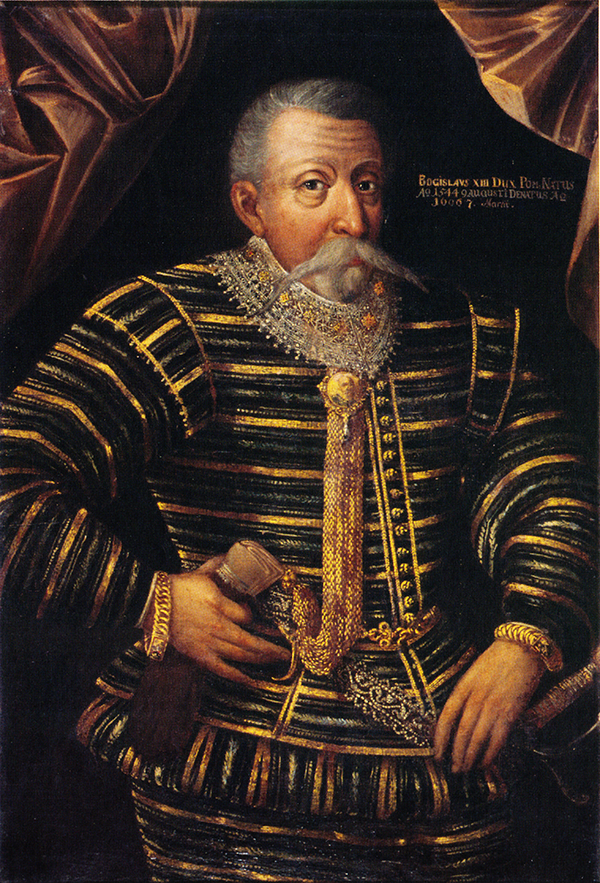
Herzog Bogislaw XIII.
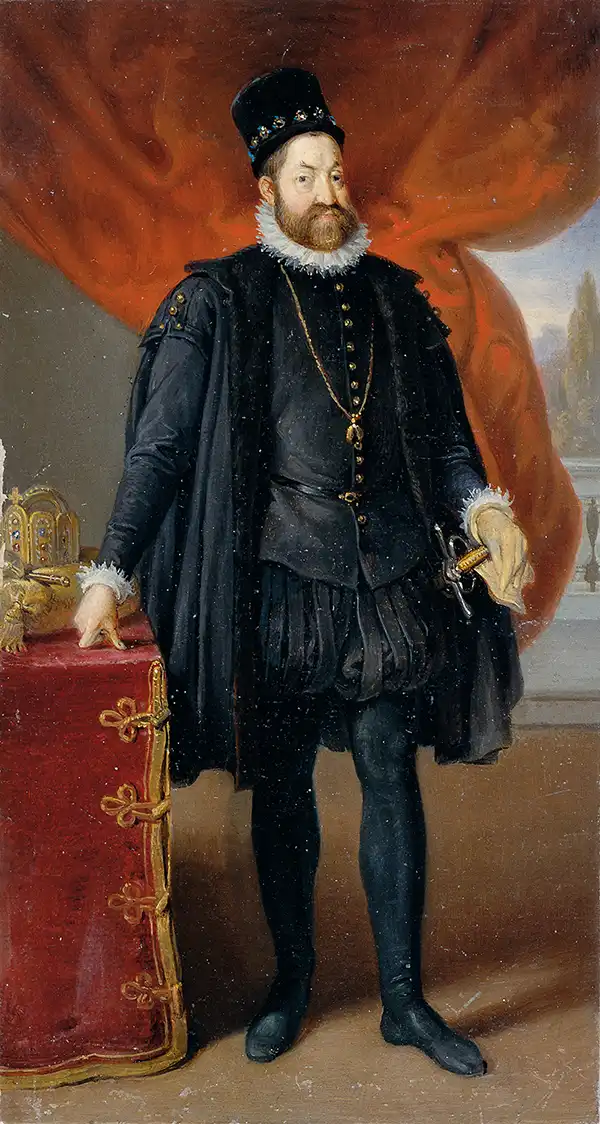
Emperor Rudolph II.
Emperor Rudolph II.
Prag um 1600
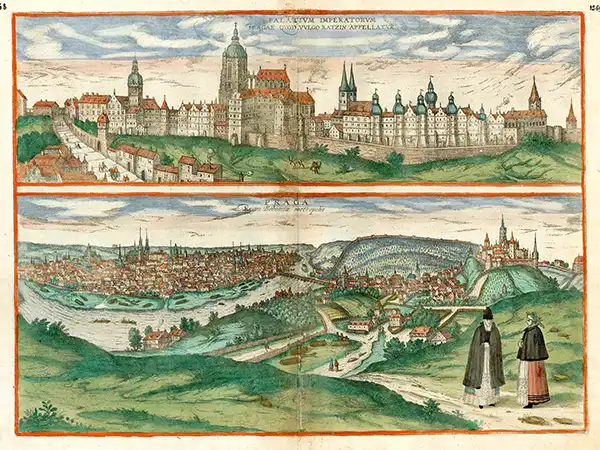
In 1593, Isabella, describing herself as a „poor woman innocently ruined“ (9), who had been „wandering around for a while“ because „poverty forced me to seek what was rightfully mine in a proper legal manner“, turned to Emperor Rudolph II in Prague, whom she addressed „as a merciful helper and protector of all poor oppressed people“. Directly subordinate to the emperor was the Imperial Court Council, which adjudicated property disputes in the Empire and heard appeals, Isabella complained to the emperor about the suffering she had endured and requested that „in addition to the restitution of my property“, he take pity on her in „consideration of my great innocence“. She further asked him to instruct Bogislaw XIII, Duke of Pomerania, and the Council of Anklam to send „all the files, together with the councillors and everything pertaining to the legal exercise of my case“ to the emperor or to herself. Moreover, she demanded that „my honour, that of my children and friends be restored“, that „my dress“, meaning her social standing, be returned and that she be granted guardianship over all her property.
The Emperor responded promptly. In his letter to Duke Bogislaw XIII (10), he confirmed receipt of the case files. At the same time, however, he complained that „the main issue“ was presented in „strong contradiction“ by the opposing parties. He therefore instructued the duke to act graciously, and to „help the poor, afflicted woman“, by ensuring that justice was done and that proper legal proceedings were followed. He further ordered that her property be secured, an inventory be drawn up and Daniel Radtke’s „evil housing“ (unlawful occupancy) brought to an end in order to improve the circumstances of Isabella and her child. The emperor also insisted that she receive the 100 talers in alimony owed to her by the city. Although the duke outwardly complied with the emperor´s wishes, her remained resistant in the face of what he called „the woman’s mischief“ (11). He assured the emperor that he would carry out the order, even though the city maintained that it had not confiscated her property and that Radtke had no involvement in the matter.
Under imperial protection, Isabella ventured a bold step. On 17 June 1594, she appeared at the Imperial Diet in Regensburg, where the emperor was also in attendance. There she met the envoys of the Duke of Pomerania, Count von Eberstein and Henning von Ramin, and requested a passport to be safe „where she wants to travel“. (12) The envoys proposed granting her safe conduct and permission to return to Pomerania, excluding Anklam, and recommended that she be „swiftly granted justice“. The condition, however, was that she „renounce and waive all claims against the Principality of Stettin and its relatives and related persons“. As only the duke himself could authorise the passport. Isabella requested one month to consider the offer. Although she initially agreed to the envoy’s condition, she also asked for a „favourable preliminary decision“ as a safeguard, a request that was ultimately denied. Isabella proved both prudent and well advised. Deeply distrustful of the judiciary in Pomerania, she resolved instead to pursue an appeal either before the Imperial Court Council (RHR) in Prague or at the Imperial Chamber Court (RKG) in Speyer. At that time, she gave an address in Prague`s Plattnergasse as her place of residence.
At first, the greatest obstacle was the remission of the feud oath that Isabella had once sworn in Anklam. In 1597, Emperor Rudolph II urged Bogislaw XIII to „proceed swiftly“ with the matter before the court in Wolgast. (13) The request was complied with, and the feud was formally remitted. However, the council of the Hanseatic town and her alleged husband continued to resist demands that she be paid alimony from her estates. Instead, they claimed that she was in debt, citing a sum of 80 talers that supposedly had to be settled first. Their jusification was that „the pot was empty“, meaning that the municipal coffers had been exhausted. According to Isabella`s own account, her assets amounted to 20,107.70 talers. (14)
Imperial Chamber Court in Speyer
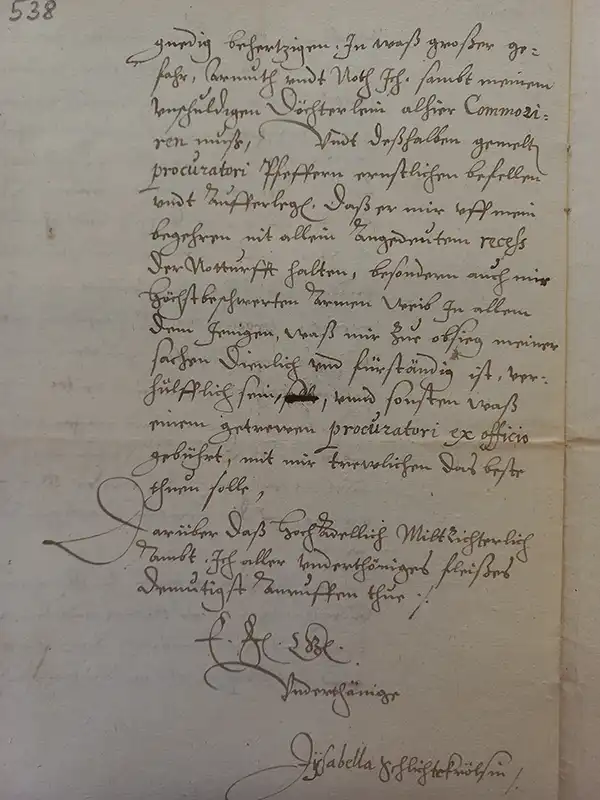
A year later, Isabella’s appeal proceedings began, not before the RHR in Prague, but before the RKG in Speyer. There she resided in Hundkgasse with Elisabeth Grinnmann. The RKG offered subjects the opportunity to appeal decisions made by lower courts, including those of territorial sovereigns, provided that the prescribed legal procedures had been followed. Isabella had fulfilled this requirement. What followed was a ten-year trial, marked by numerous procedural disputes, statements of claim, resposes and replies. Dr. Pfeffer, procurator and legal representative of Isabella, accused both the duke and the council of Anklam of numerous irregularities and procedural violations. According to the complaint, Isabella had been accused of witccraft „without any reasonable suspicion or accusation“ (15) and „out of pure envy and malice“, had been subjected to torture and imprisonment without sufficient cause. Although „no criminal offences were found in her“, she was nevertheless expelled from both the town and the duchy, while all her possessions and property were „forcibly withheld“ from her, causing her to have „endured harm and disadvantage innocently for so long“. Her legal counsel argued that the defendants had violated Articles 9,10,11,12, and 14 of Charles V’s Halsgerichtsordnung (Criminal Code). On these grounds, he demanded compensation from the defendants in the amount of 20,000 Reichtstaler in gold from the defendant, the Duke of Pomerania, as „due compensation and restitution“, as well as a further 20,000 Reichstaler from the town.
The opposing party, the defendants, now Duke Phillip Julius and the town council, took their time and did not submit a response until five years later. In 121 articles, the rejected all accusations, declaring that they were „no guilty of responding to them“. They admitted that Isabella had been tortured, imprisoned, and expelld from the country because she was „suspected of being a sorceress“ (16). While they started that they were unable to comment on certain allegations, such as the severity of the torture, they denied most of claims, including her alleged losses amounting to 40,000 Reichstaler, as unfounded. The duke maintained that he did not wish to be „complained of by the plaintiff“ and dismissed the entire lawsuit as slanderous, insisting that he be „released from the frivolous lawsuit“.
The defendants‘ strategy was to uphold both the accusations against Isabella and the punishment imposed upon her as lawful, while simultaneously discrediting her family and attacking her honour. They did not acknowledge her claim to her property and possessions in any respect.
In accordance with the provisions of the „Carolina“, „two or three credible witnesses who speak from true knowledge“ were examined. However, two of the three witnesses had already died. According to the Halsgerichtsordnung (criminal court regulations), anyone who „has particular association with sorcery and sorceresses“ or „engages in such suspious activities, gestures, words and behaviour“ and „is otherwise notorious for the same“ proviedes a legitimate indication of sorcery. (17) One of the witnesses, Isabella`s servant Peter Züssen, testified that she had maintained contact with a woman known as the Wedelsche. According to his statement, this woman who lived in Mecklenburg, was suspected of being a fortune teller, sorceress and worshipper of the devil. He claimed that Isabella had „spent whole days and nights talking suspiciously“ with her, and had sent her butter and eel. Furthermore, he stated that, through a hole in the wall, he had seen a black dog standing between the two women.
As early as 1588, another woman in the town, known as Luchtische, was arrested and accused of witchcraft. According to reports, her maid had spread the rumour that she possessed a devil, which she kept in a glass jar. This devil was suposedly responsible for bringing her prosperity in trade and business. The Luchtische was also accused of having driven the maid insane. The latter was said to have run through the town „naked and bare“ and was later found dead in a pit. Under torture, the Luchtische confessed that Isabella Schlichtekrull possessed two devils, Hildebrandt and Luutz, who procured grain and money for her. She further alleged that Isabella had committed adultery with her fisherman’s servant, Klaus Krause. Krause feared Isabella because she constantly shouted at him in anger. Her later claimed that he outbursts had caused him physical harm and that he had „become incapable of all marital duties“. Krause was regarded at Isabella`s enemy, as he had hoped to marry her after the death of her first husband. These accusations, however, did not save the Luchtische herself. She was convicted of witchcraft without a formal trial for allegedly causing the maid`s death and was punished „with fire“. In addition to those townpeople who envied Isabella’s commercial success, even her husband accused her of being in league with the devil. Accordingn to his account, the devil had appeared at her „wedding“ in the form of an unknown old woman who brought her a large sum of money. Money played a significant role throughout the case. The council accused Isabella of concealing her cashin prepartion of flight. However, buying money for safekeeping was a common practice at the time, intended to protect it from servants and even family members. Nevertheless, the coucil searched for the hidden funds until they eventually discovered them in a pit.
The defendants acknowledged that Isabella`s parents had lived in Pomerania, but they claimed that her father had been a criminal who had been imprisoned for theft in Holstein, where he subsequently died. According to their account, Isabella arrived in Anklam, the small town on the Peene River only afterwards, „keeping herself poor and humble“ and „serving as a maid for citizens and fishermen“. (18) They portrayed her as nothing more than a poor fisherwoman who married her first husband, J. Lüdtke, „a son of higher standing“, and bore him children, although he was allegedly able to provide only meagre support for the family. The defendants further argued that her imprisonment and repeated torture had been necessary because, despite repeated warnings, she had done nothing to clear herself of the accusations. Isabella remained silent. They maintained that they had acted with due consideration and in accordance with the judicial regulations, and that the painful interrogations had been conducted in such a manner that she was „injured as little as possible by wounds and harm“. (19) Nevertheless, they continued to regard her as notorious for witchcraft, citing her alleged use of „all kinds of demonic words“, her habit of „paying little attention to the church and the sacraments“, and her frequent invocation of the devil’s name. For these reasons, they argued that she had „deserving expulsion from the country for such superstitious curses“. The defendants even alleged that Isabella had employed „abominable superstitious things against her husband“ (D. Radtke) in order that „he would not pursue whores, or would beat the Clegerin any more“.
With regard to her property, „which the Clegerin would like to claim“, the town maintained that it had „done very little“ because after her release from prison, she „never had such property“. Her husband asserted „that all of them had been sold with the knowledge and consent of the Clegerin herself“. According to this argument, there had been no reason to confiscate her possessions or enter them into the register of confiscated property. Consequenetly, the defendants claimed that they bore „no blame for the destruction of the property“.
The Imperial Chamber Court in Speyer responded promptly with the plaintiff Isabella Schlichtekrull`s reply to the defendant`s submission. (20) In a document extending to one hundred pages, her legal reprensentatives not only accused the defendants of serious procedural violations but also substantiated these allegations by reference to the provisions of Charles V’s Halsgerichtsordnung (criminal procedure code). The document provided detailed legal commentary on the handling of evidence, the examination of witnesses, and the use of torture. Among other criticisms, it highlighted the defendant`s failure to conduct a thorogh investigation of the accusations, particularly in their examination of witnesses. Rather than investigating the allegations themselves, the defendants had relied on rumours and „nothing but fairy tales“. In doing so, they had also disregarded the proper sequence of judicial proceedings. According to the plaintiff`s argument, a judge should first have established the facts, then relied on solid evidence concerning who had commited the alleged offence, when and where it had occurred, why it had happened, and what damage had resulted. Only after such evidences had been established should the plaintiff have been subjected to painful questioning.
As requested by the defendants, namely „to compel the plaintiff to give a correct and decisive answer“, Isabella was summoned to appear before a notary in Speyer. There, she was questioned in detail regarding each of the allegations brought against her. Concerning her relationship with Mrs Wedel, who was alleged to have been her witch mistress, Isabella explained that her husband, J. Lüdtke, had suffered from a prolonged illness for which no remedy had proved effective. She then heard of Mrs Wedel, a woman in Mecklenburg, who was reputed to posess healing power. Isabella brought her husband’s urine to her, whereupon Mrs Wedel prepared a medicinal potion. According to Isabella´s testmony, „he recovered from his illness“. In gratitude, she and her husband frequently sent Mrs Wedel fish and butter and visited her on several occasions.
The RKG challanged the crediblity of the two servants, Züssen and Krause, who had been presented as witnesses by the defendants. It pointed out that neither man had testified under oath and that their statements were therefore unreliable. Züssen, who claimed to have witnessed the sorcery allegedly practised by the Wedelsche, was described as „a public thief who was hanged on the gallows“. As for Krause, who alleged that Isabella´s shouting had rendered him „incapable of all marital acts“, the RKG responded by asking, „how could he have known that“, since he was unmarried. Consequently, it argued that „he must have committed fornication and lewdness“.
As for the Luchtische, she too was dismissed by the RKG as „absurd and unbelievable“. She had claimed that Isabella had committed adultery with Krause six years earlier. Aside from the RKG´s critisism of questioning a defendant „with which he intends to accuse others of the same crime“, Isabella denied the allegation and stated she had confronted the Luchtische. The latter had told her that she had been „questioned extensively“ because of her and that she had therefore been „subjected to excessive torture, so that her belly had burst and her intestines had fallen out of her body“.
Isabella was suprised at the disparaging portrayal of her parents and explained that they had been well known throughout the town because they were long-established residents. She herself had not arrived in Anklam in poverty or destitution but had been born there and baptised in St. Nicolas‘ Church. Nor did she accept any disparagement of her fish trade, from which she paid the duke 500 Talers a year. On contrary, it was „no small and poor opportunity“, but rather „usually brought in a large and very noticeable amount annually“. Anyone considered respectable in the town owned a Zeeseboat and sold „whole barrels full“ of fish.
Under torture, the RKG observed, „such statements and confessions are null and void and of no force whatsoever“. The defendants and a judge ought to have taken greater care to ensure credible reports and suspicions, rather than resorting to torture. They should instead have made enquiries and „diligently investigated … whether the misdeed had actually taken place, whether the suspicion was sufficient or not“. The defendants knew that „they had wronged the plaintiff and done too much, and yet they were unable or unwilling to desist“. They relied on witnesses only after the fact in order to „obtain a remedy and a pretence for themselves and to fish for evidence“. Overall, „no legal proceedings were held with her, which is wrong and cannot be justified“. According to the RKG, in such violations of the Criminalis Carolina, „the judge and the authorities shall also be severely punished for this reason, … that they shall make due reparation to the accused for the shame, pain and damage inflicted upon her“.
According to the RKG, the defendants were obliged, „of answering to the plaintiff for all such goods as they have inventoried and described and of returning them to her in fll“. Had the inventory been properly compiled, it would have been evident „that she and no one else had been in possession of the goods“. Isabella denied that she had ever granted her husband Radtke or her children permission to take possession of, or dispose of, her property. On this basis, she maintained that the defendants, both the mayor and the council, were required either to restore the goods or to compensate her in the amount of 20,000 Talers. She further noted that the defendants had actively participated in the search for her cash without reservation. Isabella also contested the justification for her detention, namely the alleged rist of flight. In her account, she had safeguarded her assets and „removed it from her unfaithful husband, who had taken everything he could from her and squandered it on frivolous people“.
In this context, Isabella characterised „her unfaithful, supposed husband“ as „her worst and most evil enemy“, who, in her view, had acted out of revenge and had been „the true instigator“ of her misfortune.
The RKG likewise took note of this aspect, observing that „defendants themselves acknowledged this in their report, which they sent to His Imperial Majesty, or most gracious lord in Prague, to His Imperial Majesty’s Court Chancellery. For therein they report that „this husband of hers, the plaintiff, had her defer and put away“.
The ultimate outcome of the proceedings remains unclear. The defendants did respond, albeitwith evident reluctance. At issue was, in particular, the question of alimony which Isabella was to recieve from her estates. However, the defendants again evaded a substantive resolution, arguing that the estates were by then in the posession of third parties and further maintaining that they had not even „inquired“ into the seizures demanded from Radtke and her son-in-law. (21) This effectively brought the matter to a close.
The final correspondence relating to the case dates back to 1614. Emperor Matthias in Prague intervened personally on Isabella’s behalf and ordered the mayor of Anklam to comply with a „summons“ to Speyer. (22) The delivery of this imperial mandate was formally acknowledged by the messenger, who confirmed that he had handed the letter directly to the mayor. (23) It is therefore plausible that Isabella had died in the meantime, with the RKG leaving the case among the many unsolved files that accumulated in its records.
A letter from Isabella to the RKG, after 1600
Isabella in front of the RKG
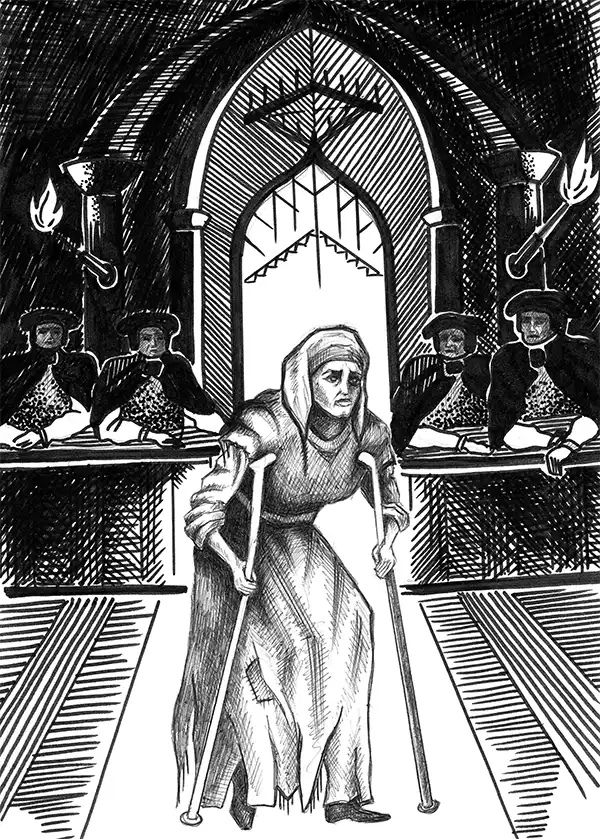
(Drawing: Nadezhda Khomiakova, 2025)
Angelika Glander
References:
- Oestmann, Peter, Hexenprozesse im Reichskammergericht (Whitch Trials in the Imperial Chamber Court), Böhlau Verlag Köln Weimar Wien, 1997, p. 598 ff.
- Court records, Imperial Chamber Court, Speyer, reply from the RKG, 21 March 1607
- Court files, RKG Speyer, Designatio iuratoria, Exaudi 1603
- Court files, RKG Speyer, Extract from the official register of the Princely House of Wolgast, 11 September 1596
- Court files, RKG Speyer, Replica of the RKG, 21 March 1607
- Court records, Imperial Court Council Prague, (RHR), letter from Isabella Schlichtekrull to Emperor Rudolph II, 1594
- Court records, RKG Speyer, statement of claim by procurator Dr Pfeffer, 1598
- Court records, RHR Prague, letter from Isabella Schlichtekrull to Emperor Rudolph II, 1593
- Ibid
- Court records, RHR Prague, letter from Emperor Rudolph II to Duke Bogislaw XIII, 18 April 1594
- Court records, RHR Prague, letter from Duke Bogislaw XIII to Emperor Rudolph II, Februar 1594
- Court records, RHR Prague, minutes of the Imperial Diet of Regensburg, June 1594, for RKG 1603
- Court records, RHR Prague, letter from Rudolph II to Duke Bogislaw XIII, 10 Oktober 1597
- Ibid
- Court records, RKG Speyer, statement of claim by Dr Pfeffer, RKG, 1598
- Court records, RKG Speyer, statement of defence by the Council of Anklam, 1604
- Peinliche Hals- und Gerichtsordnung Karl V., Barth M.D.X.C., A.D. 1566, p. 44
- Court records, RKG Speyer, statement of defence by Duke Julius Phillip and the Council of Anklam, 1604
- Peinliche Hals- und Gerichtsordnung Karl V., Barth, A.D. 1566, p. 55
- Court records, RKG Speyer, „Petition“/reply from the RKG, 21 March 1607
- Court records, RKG Speyer, letter from Council of Anklam to the RKG, 4 Februar 1606
- Court records, letter from Emperor Matthias to the Council of Anklam, November 1613
- Court records, letter from postmaster Johann Kegele to RKG, 26 May 1614